
Some destinations impress immediately, and others reveal themselves slowly, through repetition, familiarity and quiet recognition. Assisi belongs unmistakably to the second category.
Set in the gentle heart of Central Italy, in the Umbria region, between medieval stone and silvery olive groves, Assisi is often introduced as a place to visit once, briefly, almost reverentially. Many arrive with a single image in mind, that of St Francis, his basilica, and a sense of spiritual obligation fulfilled within a few hours. Yet this approach only brushes the surface of a town whose true identity emerges over time.
Assisi is not a destination to be completed. It is a place to which one returns, each time with deeper understanding, fewer expectations, and a greater openness to nuance.

A town that unfolds with time
To understand Assisi, one must first understand its relationship with time.
In the early morning, before the arrival of day visitors, Assisi feels introspective and almost suspended. The light moves slowly across stone façades, shopkeepers lift shutters without urgency, and footsteps echo softly through narrow streets. At this hour, the town feels lived in rather than observed.
As the day progresses, Assisi shifts its rhythm. Voices multiply, movement intensifies, and the town assumes its more familiar, outward-facing role within Central Italy’s cultural landscape. Yet those who stay overnight discover that this is only one layer of its character.
In the evening, when the hills darken and silence returns, Assisi regains its balance. Locals reclaim the streets, conversations slow, and the town settles into a deeply human pace. Returning travelers quickly learn that Assisi is not defined by a single moment, but by its transitions, by what happens between arrival and departure.
The town of St Francis has always been central in the Umbria region, historically playing a pivotal role in Central Italy too, especially on a spiritual level. Nowadays, Assisi is one of the most underrated Italian destinations, but it’s gaining the visibility it deserves, always maintaining authenticity, demonstrating the true soul of Umbria and Central Italy.
Assisi and St Francis, beyond the religious symbol
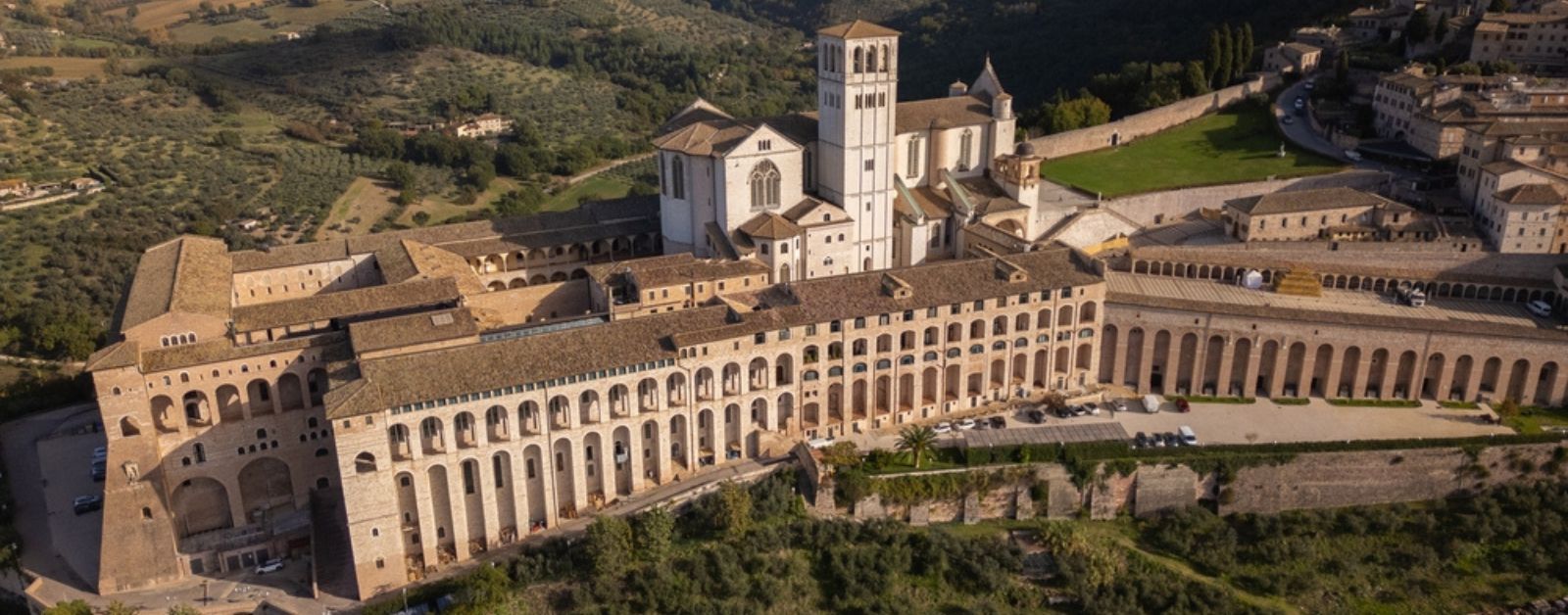
Any honest reflection on Assisi must acknowledge the profound presence of St Francis, whose life and philosophy continue to shape the town’s spiritual and cultural identity. The Basilica of St Francis is both a masterpiece of medieval art and a place of deep symbolic gravity, anchoring Assisi within the collective imagination of Central Italy and far beyond.
A quieter Assisi beyond the icons
Yet Assisi is far more than its most famous monument.
Those who return begin to look elsewhere, toward the fabric of daily life rather than its symbols. Small churches tucked behind unassuming façades, cloisters that open unexpectedly onto silence, details in stone worn smooth by centuries of passage. These are not secondary experiences, but essential ones.
In Assisi, Umbria, spirituality is not confined to religious architecture. It exists in gestures, in restraint, in the deliberate absence of excess. The town teaches that meaning often lies in what is left unsaid, and unseen.

The town of St Francis and its perfect fit into the landscape of Central Italy
Assisi cannot be understood without its landscape.
The town rises gently from the slopes of Mount Subasio, a protected natural park that frames Assisi with open horizons, oak forests, and walking paths that invite exploration rather than conquest. Here, nature and culture exist in seamless continuity, one flowing naturally into the other.
The paths that surround Assisi are not designed for haste. Whether following ancient routes associated with St Francis (like the one leading to Eremo delle Carceri) or wandering more freely across the hills, walking becomes a form of meditation, a way of aligning the body with the rhythms of Central Italy.
For travelers accustomed to Italy’s great art cities, this intimacy between town and countryside feels transformative. One steps out of medieval streets and, within minutes, into silence and open space. Returning to Assisi often means walking further, lingering longer, and allowing the landscape to speak as eloquently as the architecture.
Assisi, taste and the comfort of authentic luxury
Assisi expresses itself not only through stone and landscape, but also through taste.
Umbrian olive oil, vibrant and peppery, is one of the purest expressions of this territory. It is not an accessory but a foundation, reflecting the groves that surround the town and the agricultural traditions of Central Italy. Used with restraint and confidence, it transforms simple dishes into expressions of place.
Food and wine as continuity

Wine in and around Assisi follows the same philosophy. Balanced, food-driven, and deeply rooted in local identity, it accompanies rather than competes. Meals unfold slowly, often in intimate spaces where hospitality is defined by warmth rather than formality.
For high-end travellers seeking comfort and luxury without ostentation, Assisi Umbria offers a rare equilibrium. Here, quality is felt rather than displayed, and luxury resides in atmosphere, care and time.
Assisi through the seasons
Those who return to Assisi quickly realize that seasonality shapes the experience profoundly.
Spring brings a sense of renewal that is both visible and intangible, culminating in the Calendimaggio, when Assisi steps back into its medieval identity through rituals, colors and music that belong first to the community itself. This is not a spectacle created for visitors, but a living tradition that reveals the town’s enduring relationship with its past.
Autumn offers clarity and grounding. Olive harvests animate the countryside, light sharpens, and Assisi feels contemplative, inward-looking, perfectly aligned with the slow rhythms of Central Italy.
Winter strips the town down to its essence. With fewer visitors and longer silences, Assisi reveals a more intimate face, one that rewards those willing to experience it without mediation.
For travelers who already know Italy, who have experienced its most celebrated cities and now seek depth, authenticity and quiet sophistication, Assisi offers something rare. It is a place where spirituality is lived rather than declared, where food and landscape speak the same language, and where Central Italy reveals one of its most balanced expressions.
To return to Assisi is not to repeat the same journey, but to continue it. Each visit adds nuance, perspective and intimacy, reinforcing the sense that this is not merely a destination, but a presence that remains.
And that, perhaps, is Assisi’s most enduring gift.


Rispondi