
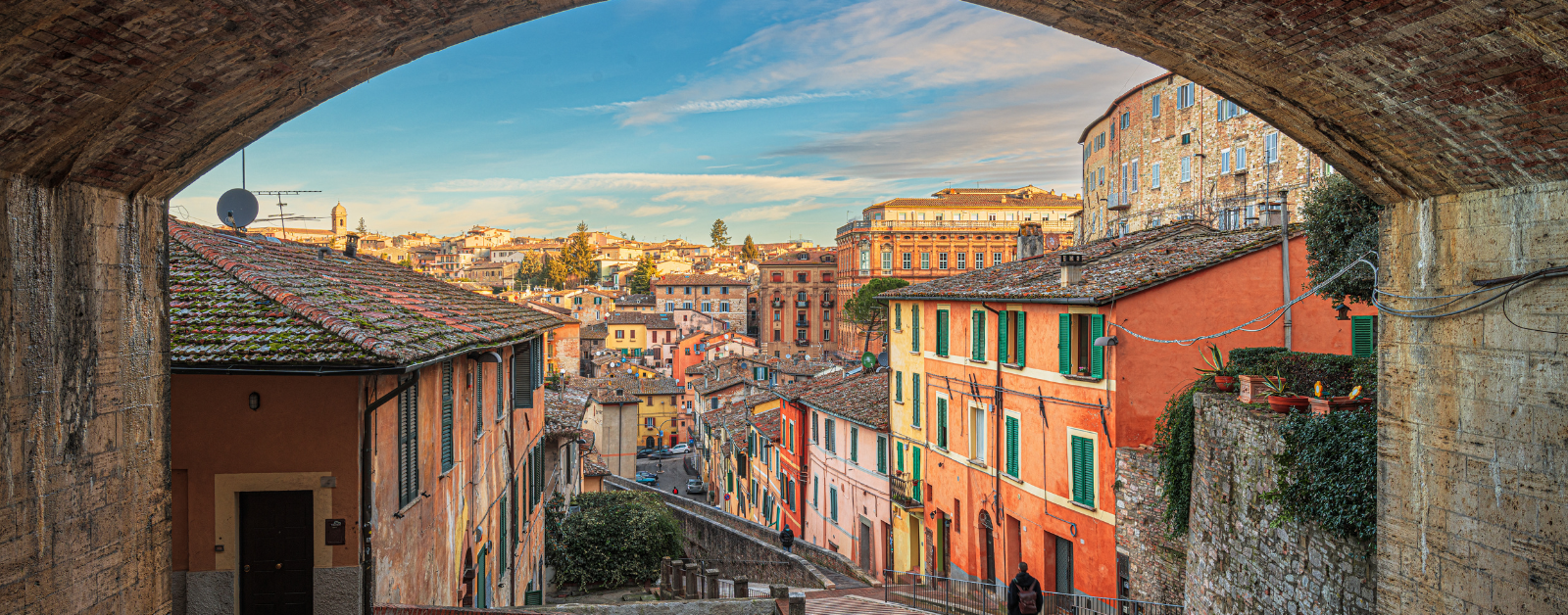
When people imagine Italy, they often picture places they already know by name. Florence, Venice, Rome, sometimes Tuscany (as an idea more than a location). Yet Italy’s deepest character does not live in its most photographed destinations. It lives elsewhere, quietly and persistently, in villages that have never needed an audience.
This is the Italy that rarely makes headlines or “must-see” lists. An Italy of small towns, inland landscapes, and daily lives shaped by continuity rather than demand. Often labeled hidden Italy or non-touristy Italy, these places are not hidden at all. They are simply not built to perform, and they are perfect to experience the true soul of Italy, far from the crowds and over tourism.
Understanding Italy through its villages means shifting perspective: from spectacle to substance, from movement to presence, from highlights to habitat.
Villages as the original Italian landscape

Italy is, at its core, a country of villages. For centuries, life unfolded in compact communities shaped by geography, agriculture, and shared labor. Towns rose on hills for defense, clustered around water sources, or formed along trade routes that no longer exist. In the regions of central Italy, villages were never absorbed into large metropolitan systems. They retained their scale, their social structures, and their relationship with surrounding land.
These places were not designed for visitors. Streets are narrow because they predate cars. Houses face inward because community mattered more than views. Public spaces exist for necessity, markets, meetings, worship, not for entertainment.
Villages are not a backdrop. They are the infrastructure of Italian life.
Why “hidden” Is the wrong word
Calling these villages “hidden gems” implies they are waiting to be discovered. In reality, they have always been there: lived in, worked, and maintained.
What makes them feel invisible today is not secrecy, but lack of translation. They do not adapt easily to tourism language. They do not explain themselves. They do not compress centuries of life into digestible highlights. Non-touristy Italy is not difficult to find geographically, it is difficult to approach culturally as it pushes back over tourism and values quality over quantity.
These villages reward time, repetition, and humility. Without those, they can appear quiet, even uneventful. With them, they reveal a density of meaning that famous destinations rarely sustain.
The rhythm of Italian village life

Life in Italian villages follows a rhythm that resists acceleration. Days are structured around essentials: work, meals, rest, social contact. Shops open and close according to human needs, not continuous availability. Silence is part of the soundscape. Familiarity replaces novelty.
People know where they are supposed to be, and when. The same faces reappear and conversations continue where they left off days before. This rhythm is not nostalgic, it is practical. It reduces friction, preserves energy, and it allows attention to settle.
In villages, slow living is not a choice: it is the only functioning system, and that’s why it naturally attracts slow travelers.
Architecture that reflects use, not image
Italian villages are often described as “picturesque,” but that word misses the point. Their beauty comes from use, not design.
Stone walls are thick because they insulate. Staircases are uneven because they were built incrementally. Houses overlap because land was shared, adapted, negotiated. Nothing here was built to impress, but everything was built to last.
This architectural honesty creates environments that feel grounded and human. You sense that life has truly happened here.
Italian food without performance
In non-touristy Italy, food is not an attraction. It is nourishment, culture, and continuity. Village cooking responds to what is available, affordable, and seasonal. Menus are short. Recipes repeat. Ingredients matter because they come from nearby land or familiar producers.
There is no pressure to innovate endlessly. Quality is measured by reliability, not surprise. Eating in these villages is not about discovery. It is about belonging, even temporarily.
Why central Italy resist mass tourism

Central Italy Italian villages resist tourism not out of hostility, but because their systems are incompatible with scale.
- There are few large accommodations
- Infrastructure prioritizes residents
- Daily life does not pause for visitors
- Social spaces are functional, not performative
Tourism that arrives here must adapt, not the other way around. This naturally filters travelers, attracting those willing to slow down, observe, and integrate, even briefly. This resistance is not a flaw. It is a form of cultural protection.
A different way of traveling through Italy
Traveling through central Italy’s villages requires a different mindset. You may not “see” much in a day. You may repeat the same walk. You may spend hours doing very little. Yet what you gain is orientation, a sense of how life fits together.
Non-touristy Italy teaches travelers to:
- stay longer
- move less
- listen more
- expect less spectacle and more substance
Village life in Italy is not frozen in time: traditions adjust, young people leave and sometimes return. The difference lies in pace and selectivity.
Change arrives slowly, tested against existing structures, and what does not fit is discarded, while what works is absorbed.
This gradual adaptation preserves coherence. Villages remain recognizable to themselves, even as the world around them shifts.
Why Italy’s villages matter today
In an age of overexposure and acceleration, Italian villages offer something increasingly rare: cultural continuity without performance.
They remind us that meaningful places do not need validation, that beauty can be quiet, and that life does not have to be optimized to be rich.
Hidden Italy is not hidden, it is simply uninterested in being everywhere at once. And perhaps that is precisely why it remains one of Italy’s greatest, and most misunderstood, treasures.


Rispondi