
When people talk about Central Italy, they often mean one thing, and one thing only: Tuscany. Rolling hills, cypress trees, stone farmhouses glowing in golden light. It’s a powerful image, and not an undeserved one.
But it is also incomplete.
Central Italy is not a brand, a postcard, or a neatly drawn region on a tourist map. It is a cultural geography: a complex, layered area shaped by history, agriculture, language, and ways of living that have little to do with fame and everything to do with continuity.
To understand what Central Italy really is, we need to look beyond Tuscany’s borders and step into a quieter, deeper Italy.

Central Italy is not a region (and that matters)
Central Italy is not a single administrative unit: it is a cultural and historical area that includes parts of several regions, each with its own identity, yet bound together by shared rhythms of life.
At its heart are places such as Umbria, often described as “the green heart of Italy,” and Marche, stretching from the Apennines to the Adriatic Sea. It also includes southern Tuscany, northern Lazio, and inland territories that rarely appear in mainstream itineraries.
What unites these areas is not a single style or aesthetic, but a shared relationship with land, time, and tradition. Central Italy is where the Renaissance met rural continuity, where medieval hill towns never became museums, and where daily life still follows patterns shaped centuries ago.
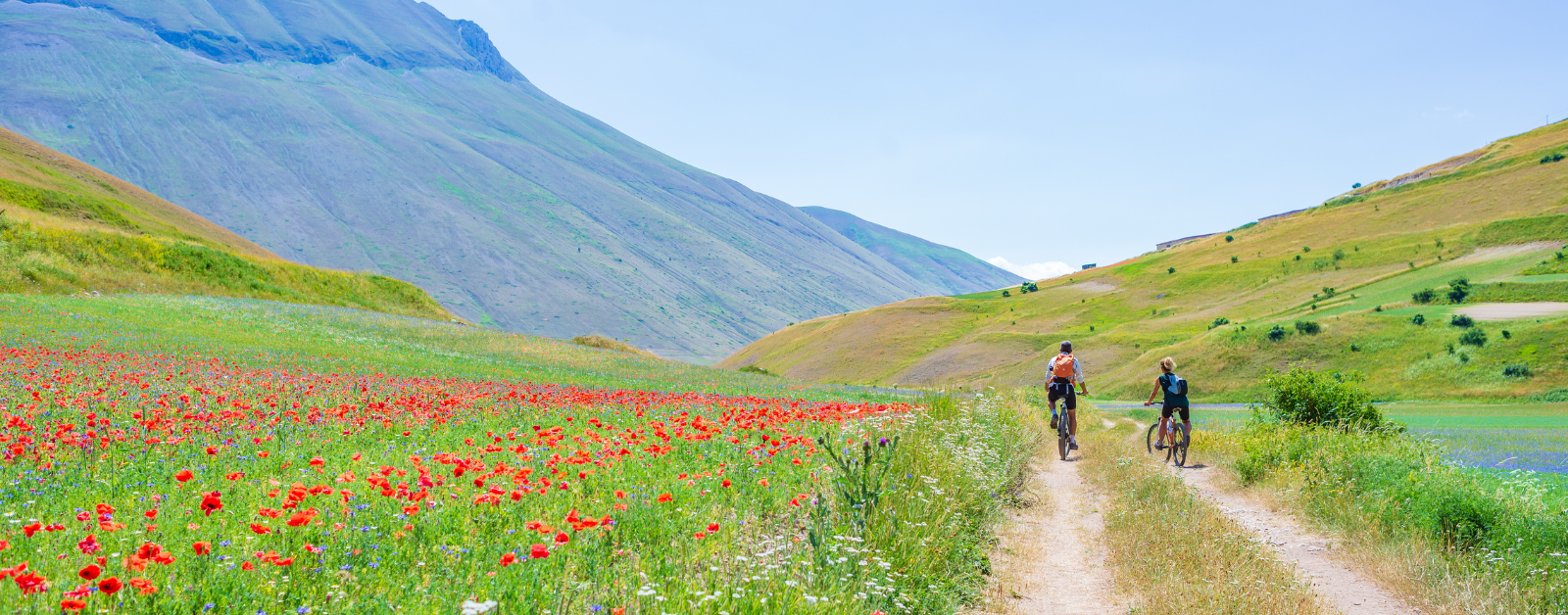
One of the defining traits of Central Italy is its inland character. While Italy’s coasts often dominate travel narratives, much of Central Italy unfolds away from the sea, in hills, valleys, and mountain ranges.
The Apennines run like a spine through the territory, shaping not only landscapes but livelihoods. Farming here has always been small-scale, family-based, and deeply local. Olive groves cling to slopes. Vineyards adapt to microclimates. Forests remain places of work, not decoration.
This geography produces a quieter beauty: less dramatic, perhaps, but more intimate. It is a land meant to be inhabited, not consumed.
Beyond Tuscany: why fame distorts geography
Tuscany’s global success has had an unintended side effect: it has flattened the idea of Central Italy into a single, marketable image. In doing so, it has obscured neighboring territories that share similar depth, but not the same exposure. The good news is that, in the era of overtourism, lesser-known places are what every traveler needs.
In Umbria, towns like Spello, Trevi, or Gubbio live largely outside mass tourism, yet retain an extraordinary density of history and craftsmanship. In the Marche, entire valleys still revolve around seasonal agriculture, local markets, and village-based social life. These places are not “hidden gems” waiting to be discovered. They are living territories that never needed discovery in the first place.
Understanding Central Italy beyond Tuscany means recognizing that cultural value does not depend on visibility.

A shared cultural thread: food, time, and place
Across Central Italy, food is the most visible expression of cultural geography. But it is never separate from place. Local cuisines are shaped by what grows nearby, what stores well, and what traditions demand. Olive oil is not a condiment but a foundation. Wine is not a label but a landscape in liquid form. Recipes are seasonal because life itself is seasonal.
Eating in Central Italy is an act of orientation: it tells you where you are, what time of year it is, and who has lived here before you. This deep connection between territory and daily life is what distinguishes Central Italy from more globalized travel destinations.
Central Italy as a way of living
More than a destination, Central Italy represents a way of living rooted in balance.
Here, life is measured less by speed and more by rhythm. Days are structured around meals, seasons, and work that responds to natural cycles. The concept of slow living is not an imported philosophy, it is an inherited one.
Lunch matters. Silence matters. Distance between places matters. Even waiting has a function. This is why Central Italy appeals so strongly to travelers who are not looking to “see everything,” but to understand something.
Why Central Italy attracts a different kind of traveler
The travelers drawn to Central Italy are rarely first-time visitors to Italy. They are people who have already seen Rome, Florence, Venice, and are now looking for something less obvious and more meaningful.
They value:
- Continuity over novelty
- Context over spectacle
- Quality over quantity
Central Italy rewards attention. It does not perform. It reveals itself slowly, often through conversations, meals, and repeated visits.
This is not a place to “tick off.” It is a place to return to.
Central Italy today: preserved, not frozen

It is important to understand that Central Italy is not stuck in the past. Modern life exists here, alongside tradition, not in opposition to it.
Young producers return to family land. Small hospitality projects reinterpret old farmhouses. Crafts evolve without losing their roots. The result is a living territory that adapts without erasing itself.
This balance is fragile, and it is precisely why Central Italy matters today. It offers a model of cultural resilience that feels increasingly rare.
To ask “What is Central Italy?” is to ask a deeper question: how do we define value in travel?
Central Italy challenges the idea that importance equals popularity. It reminds us that culture is not always loud, and that refinement often lives in the background.
Beyond Tuscany’s borders lies an Italy that is not less beautiful, only less advertised. An Italy that invites you not to pass through, but to stay, observe, and belong, if only briefly.
That is Central Italy.


Rispondi